
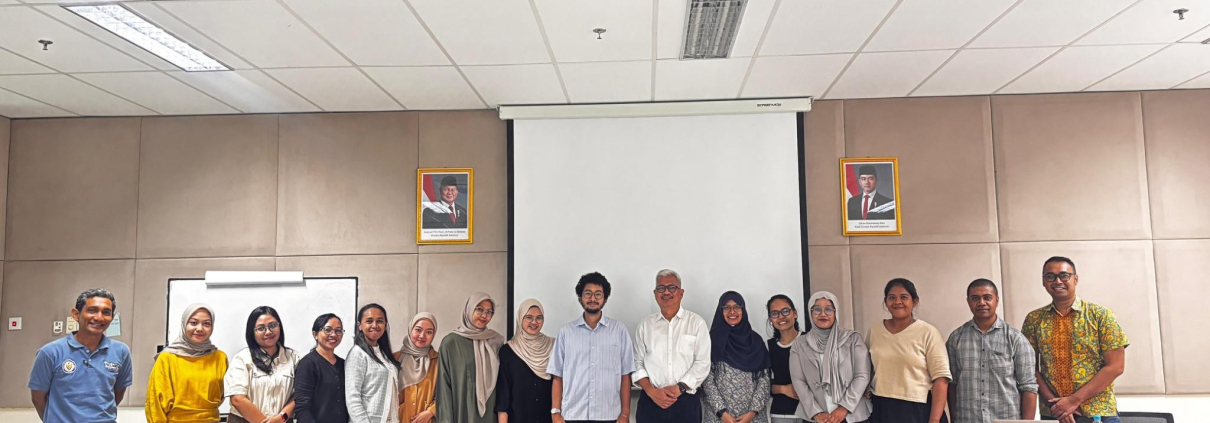


Universitas Gadjah Mada (UGM) participated in a series of DISCERN-DSS activities hosted by Universitas Muhammadiyah Yogyakarta (UMY) from September to October 2025. The activities included training sessions, a social dinner, and a project meeting, bringing together Indonesian and European partners to strengthen collaboration in digital health education.
The activities were part of DISCERN-DSS, an Erasmus+ Capacity Building in Higher Education project that supports the development of digital soft skills through co-creative practices and Digital Scenario-Based Learning (D-SBL). Through this project, partner institutions work together to design learning approaches that are relevant to the needs of future health professionals in digitally transformed healthcare systems.
UGM joined the program alongside other Indonesian partner universities, including Universitas Sebelas Maret (UNS) and UMY. European partner institutions also contributed to the activities by sharing knowledge and experience in medical education, digital learning, scenario-based learning, assessment, and professional development.
The training sessions focused on strengthening participants’ understanding of D-SBL and its application in health professions education. Participants discussed how learning scenarios can be developed, aligned with learning outcomes, and used to support the development of digital soft skills such as communication, collaboration, ethical reasoning, adaptability, professionalism, and critical decision-making.
For UGM, the training provided valuable insights into how digital soft skills can be integrated into curriculum and learning activities. As healthcare services increasingly depend on digital systems, students need to be prepared to navigate digital health environments responsibly, ethically, and collaboratively.
In addition to the training, the social dinner provided an important informal space for partners to build stronger relationships. This interaction allowed participants from Indonesia and Europe to exchange experiences, strengthen trust, and develop a shared sense of ownership in the project.
The project meeting also played a key role in ensuring that academic activities were aligned with project implementation. Partners discussed coordination, upcoming work plans, reporting needs, financial and administrative matters, and the next stages of DISCERN-DSS activities.
UGM’s participation in these activities reflected its active role in supporting both the academic and collaborative dimensions of the project. The combination of training, informal networking, and structured project coordination helped strengthen the foundation for future work, including local training, scenario co-creation, review, and the development of D-SBL resources.
Through its involvement in the DISCERN-DSS activities at UMY, UGM continues to contribute to international collaboration in health education innovation. The project is expected to support the preparation of future health professionals who are digitally competent, ethical, adaptive, collaborative, and ready to respond to the evolving demands of modern healthcare.
Universitas Muhammadiyah Yogyakarta (UMY) hosted the DISCERN-DSS training in September–October 2025, bringing together Indonesian and European partner institutions for a series of academic, collaborative, and project coordination activities. The event became an important moment to strengthen international collaboration in advancing digital soft skills education for health professions.
DISCERN-DSS, or Digitally enhanced SCenario basEd leaRNing for Digital Soft Skills, is an Erasmus+ Capacity Building in Higher Education project involving partners from Indonesia and Europe. The project aims to improve digital health education by supporting the development of Digital Scenario-Based Learning (D-SBL) resources, strengthening educators’ capacity, and promoting co-creative learning innovation.
The training at UMY focused on introducing participants to the principles and practices of D-SBL. Through interactive sessions, participants explored how digital scenarios can be designed to support active, reflective, and problem-based learning. The training also highlighted the importance of integrating digital soft skills into health education, including communication, collaboration, ethical reasoning, adaptability, professionalism, and critical decision-making.
Participants from UGM, UNS, and UMY joined the activity alongside European partners from Aristotle University of Thessaloniki, Karolinska Institutet, and the European Union of Medical Specialists. The sessions provided opportunities for knowledge exchange between institutions, combining international expertise in digital learning and medical education with local understanding of Indonesian curriculum needs.
In addition to formal training, the activity included co-creation sessions where participants began discussing ideas for future D-SBL resources. These sessions encouraged educators, technologists, and content experts to work together in designing learning scenarios that are relevant, practical, and aligned with the needs of health professions education in Indonesia.
The social dinner became an important part of the event, offering an informal space for participants to build relationships beyond the training room. Through this setting, partners were able to exchange experiences, strengthen trust, and foster a more collaborative atmosphere for the next stages of the project.
Project and finance meetings were also conducted during the activity to support coordination across partner institutions. These meetings helped align academic planning with project management, reporting requirements, budget coordination, and preparation for upcoming activities, including local training and scenario development.
By hosting the DISCERN-DSS training, social dinner, and project meeting, UMY played a key role in creating a productive collaborative space for the consortium. The activity reinforced the project’s commitment to building strong partnerships, developing high-quality D-SBL resources, and preparing Indonesian health education institutions for digital transformation.

